II. Market intelligence
From raw activity to market intelligence.
Decentralized markets produce more raw data than any team can read. The data becomes useful only when it is connected: to entities, to venues, to liquidity, to protocol behavior, and to market structure. That connection is the work Skilt does.
A transfer is a row in a ledger. An entity repositioning across three venues while funding diverges is a market event. The difference between the two is context, and context is what Skilt provides.
The sequence
01
Market structure
The frame everything else is read against.
Intelligence about entities and flows means little without a view of the market they operate in. Skilt maintains the structural frame: price formation across venues, funding, basis, open interest, and depth, so that on-chain activity can be read against the market, not in isolation.
02
Entity intelligence
Behavior attributed to actors, not addresses.
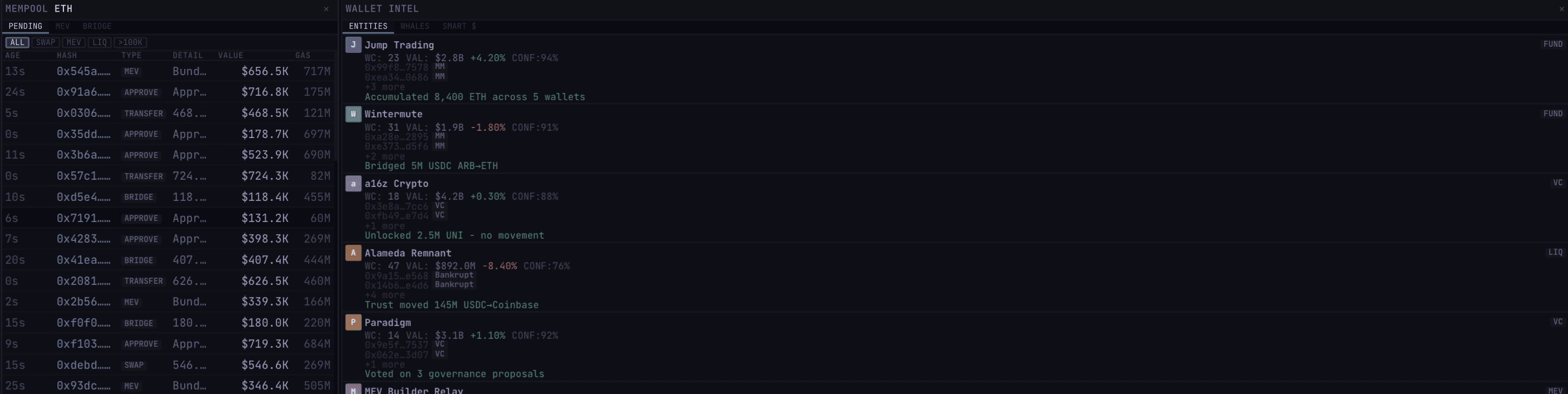
Skilt resolves wallets into entities: the funds, market makers, treasuries, and clusters whose behavior repeats. Attribution is evidence-based: linked wallets, funding patterns, and known relationships. It is presented with its basis, so teams can judge it rather than accept it.
Once an entity is resolved, its activity becomes trackable: what it holds, where it trades, when its behavior changes, and which other entities it interacts with.
03
Protocol activity
Protocols observed as economic environments.
A protocol is a place where capital arrives, rests, and leaves. Skilt watches that cycle, including deposits, withdrawals, utilization, and the entities behind them, so changes in protocol conditions are visible before they are explained by price.
04
Cross-chain flows
Capital moving between chains, followed end to end.
Bridges and message layers make decentralized markets a multi-chain system. Skilt follows assets committed, in transit, and released, and connects those flows to liquidity and market conditions on both sides of the movement.
05
Liquidity migration
Where liquidity lives, and where it is going.
Liquidity concentration is a structural fact, not a static one. Pools thin and refill; ecosystems gain and lose depth; the cost of transacting changes with them. Skilt tracks migration across pools, venues, and chains as a continuous condition.
06
Event detection
Changes surfaced because they differ, not because they are loud.
Event detection in Skilt is deliberately conservative. Conditions are surfaced when they depart from an entity's or a market's own established pattern: a cluster behaving differently, funding diverging, or liquidity withdrawing. Each event is presented with the context needed to evaluate it.
The platform does not score events, rank opportunities, or claim interpretation. It makes change visible; judgment stays with the team.
Access
Intelligence begins with the operating picture.
See how Skilt connects entities, flows, liquidity, and market structure into one environment, and judge the result against the questions your team is actually asking.