I. The operating picture
One environment for decentralized-market intelligence.
Skilt unifies the conditions that shape decentralized markets: price formation, derivatives positioning, liquidity, wallet activity, bridge flows, protocol behavior, and event-driven risk.
01
Market structure
Where price is formed, and how the venues carrying it differ.
Decentralized markets quote the same assets across many venues, each with its own depth, participants, and mechanics. Skilt observes price formation across those venues together, so the structure of the market, not a single chart, is the object being monitored.
- Price formation
- Where and how price is being set across venues, and how far each venue has moved from the consensus price.
- Venue differences
- Spread, depth, and listing differences between venues for the same instrument.
- Funding
- Perpetual funding rates by venue, including divergence from venue averages over time.
- Basis
- The relationship between spot, perpetual, and dated derivatives for the same asset.
- Open interest
- Positioning held open across venues, and how it accumulates or unwinds as conditions change.
- Volatility
- Realized and implied volatility, and the regimes they describe.
- Depth
- Resting liquidity around the mid-price, as it is distributed and withdrawn.
02
On-chain intelligence
Wallets are addresses. The market is entities.
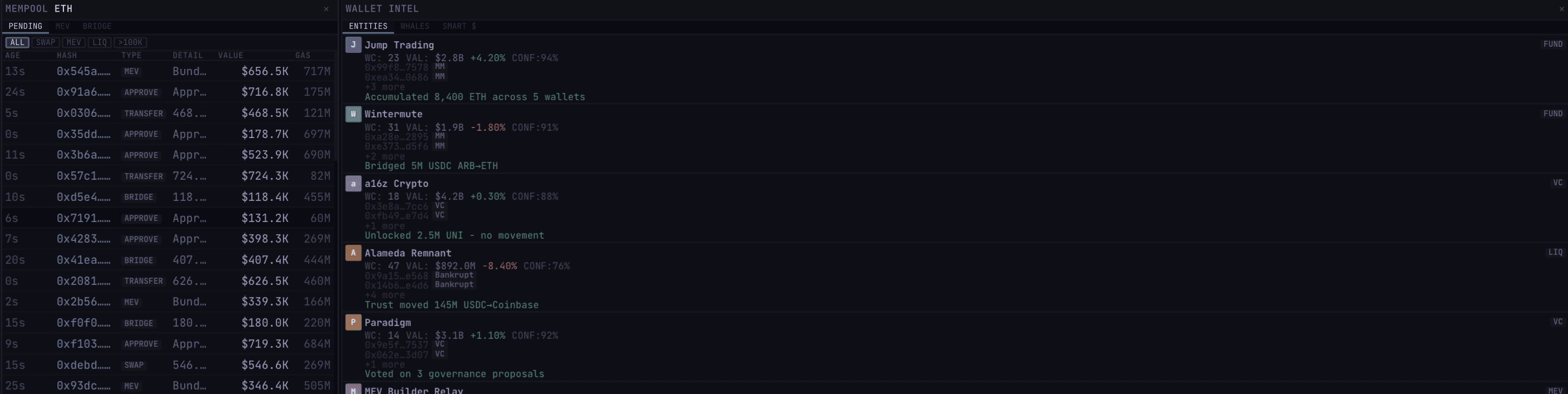
Individual wallets mean little on their own. Skilt follows entities, the clusters of wallets, venue accounts, and protocol positions that behave as one actor, and watches how they interact with the market.
- Wallet activity
- Transfers, swaps, and position changes attributed to known wallets and clusters.
- Entity relationships
- Links between wallets, venue accounts, and treasury positions that move together.
- Protocol interactions
- Deposits, withdrawals, and governance activity across protocols, per entity.
- Large movements
- Size that repositions holdings between wallets, venues, or custody.
- Bridge activity
- Assets committed to bridges and released on destination chains.
03
Liquidity and flows
Liquidity moves. The platform follows it.
Liquidity in decentralized markets migrates between pools, venues, and chains as conditions change. Those migrations are often the market's most informative behavior, and they are invisible to tools that watch one pool at a time.
- Cross-chain movement
- Capital moving between chains through bridges, message layers, and wrapped assets.
- Pool conditions
- Depth, composition, and utilization for the pools that carry a market.
- Liquidity migration
- Liquidity leaving or entering pools, venues, and ecosystems over time.
- TVL changes
- Value locked in protocols, and the rate at which it is arriving or leaving.
- Flow imbalance
- Persistent one-directional flow that signals accumulation or distribution.

04
Signals and monitoring
Conditions that change are the ones worth watching.
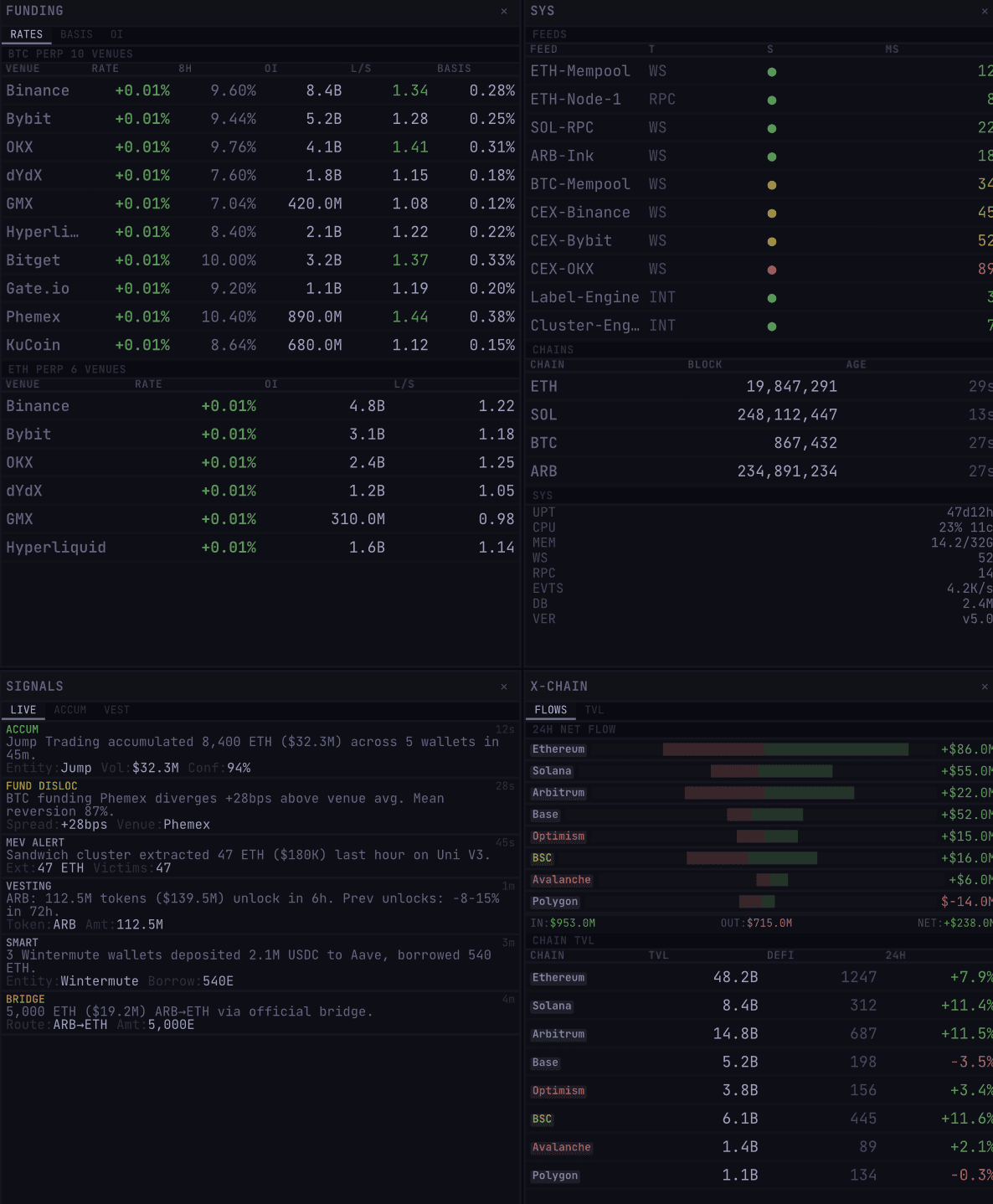
Monitoring in Skilt is not a stream of verdicts. It is a record of conditions that changed: funding diverging, liquidity thinning, or unusual flow, presented for a person to examine and interpret.
- Condition changes
- Material changes in the state a team has chosen to watch.
- Abnormal movement
- Transfers, swaps, or position changes outside an entity's established pattern.
- Funding divergence
- Venue funding rates separating from each other and from their recent range.
- Liquidity stress
- Depth withdrawal or pool imbalance that raises the cost of transacting.
- Unlocks
- Scheduled token unlocks and the supply they add to circulation.
- Liquidation pressure
- Leveraged positions approaching liquidation thresholds across venues.
Access
Evaluate the environment against your own workflow.
The platform supports trading, research, and risk teams. Access is granted per firm, and the environment is evaluated against real workflows, not a demo script.