III. Risk surveillance
Risk is often visible in the relationships between markets.
By the time risk is obvious, it is expensive. In decentralized markets, the earlier signals are usually relational: exposure concentrating in one protocol, liquidity thinning across connected venues, correlations tightening, an entity's behavior quietly changing.
Skilt watches those relationships continuously. The purpose is not to alarm; it is to give risk teams and portfolio managers the material to investigate change while it is still developing.
01
Conditions
What risk surveillance watches.
These are the conditions Skilt maintains a continuous view of. None of them is a verdict on its own. Together, they describe the shape of risk as it forms.
- Protocol exposure
- Concentration of capital and activity within individual protocols, and how it is changing.
- Liquidity concentration
- How much of a market's depth rests in a small number of pools, venues, or providers.
- Entity activity
- Behavior of significant entities and counterparties, including departures from established patterns.
- Correlation shifts
- Relationships between assets, venues, and chains tightening or breaking down.
- Abnormal flows
- Transfers and repositioning outside normal patterns for the entities and venues involved.
- Unlocks
- Supply scheduled to enter circulation, and the holdings it flows toward.
- Cross-chain contagion
- Stress on one chain propagating to others through bridges, shared liquidity, and common participants.
- Market regimes
- The broader state of volatility, funding, and flow that conditions everything else.
In practice
Relationships, watched as they change.
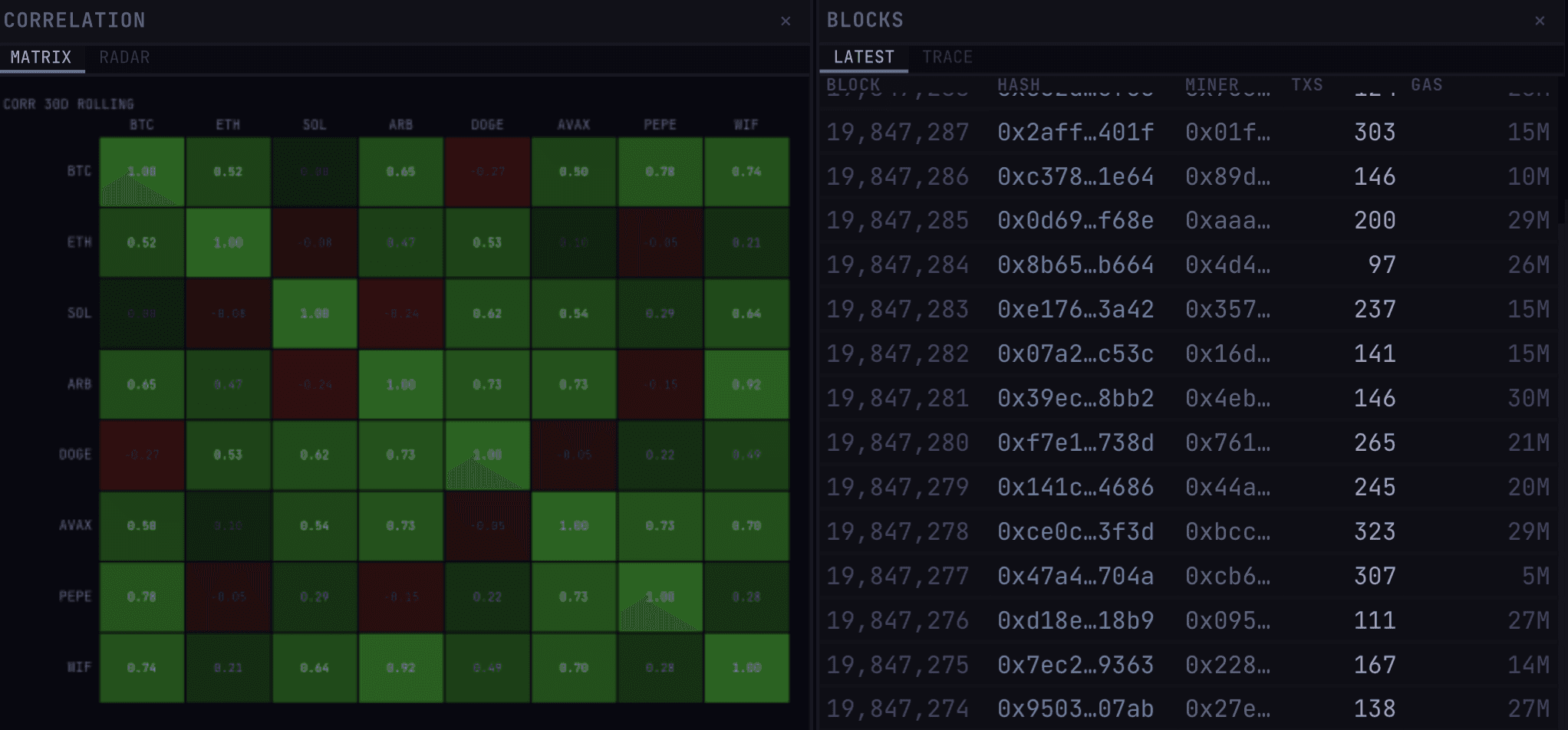
The correlation view is one example of the approach: a matrix of relationships between assets, venues, and chains, and how each relationship has moved. Rising correlation where there was none, or divergence where assets moved together, is the kind of structural change risk teams need to see early.
Alongside it, chain state and block cadence remain visible because infrastructure conditions are market conditions too.
02
Method
Surveillance, not prediction.
Skilt does not forecast drawdowns or score threat levels. It maintains a continuous, connected record of the conditions above, and surfaces the changes that matter against each team's own thresholds. The interpretation, what a change means and what to do about it, belongs to the risk officer or portfolio manager reading it.
This restraint is deliberate. Risk work depends on trust in the record, and trust comes from showing the basis: which entities, which pools, which venues, and how the condition has evolved.
Access
Put the conditions your risk depends on in one view.
Risk and portfolio teams use Skilt to watch exposure, liquidity, and correlation as connected conditions. Request access to evaluate the environment against your risk framework.